THIRD PILLAR - Portal για την Φιλοσοφία

Athena's Temple

Athena's Temple
ΑΕΙΦΩΤΟΣ ΛΥΧΝΟΣ

Search This Blog

Showing posts with label political philosophy. Show all posts

Tuesday, January 5, 2010

"Justice as Fairness: A Restatement" by John Bordley Rawls,2001

Is a revision of his classic "A Theory of Justice".
Cambridge, Massachusetts: Belknap Press, 2001.

This shorter summary of the main arguments of Rawls' political philosophy was edited by Erin Kelly. Many versions of this were circulated in typescript and much of the material was delivered by Rawls in lectures when he taught courses covering his own work at Harvard University.

Rawls is responding to criticism as well as adding further thought to his earlier A Theory of Justice.
Written shortly before his death in 2002.

In part I,
he discusses several fundamental ideas,
all of which are in his earlier book as well as Political Liberalism (1995):
-a well-ordered society;
-the basic structure of society;
-the original position;
-free and equal persons;
-public justification;
-reflective equilibrium; and
-overlapping consensus.

In part II,
he moves on to his principles of justice,
revising them from his earlier edition, which now read :

a.Each person has the same indefeasible claim to a fully adequate scheme of equal basic liberties, which scheme is compatible with the same scheme of liberties for all; and
b.Social and economic inequalities are to satisfy two conditions:
-first,
they are to be attached to offices and positions open to all under conditions of fair equality of opportunity; and
-second,
they are to be to the greatest benefit of the least-advantaged members of society (the difference principle).

In part III,
Rawls expands on his argument for the two principles of the Original position.

Here he brings in a new concept,
that of Public reason,
an idea that is not well discussed in Theory of Justice.

Part IV
takes the reader to public institutions that will be present in a just and fair society.

He lists five types of social systems:
1.Laissez-faire capitalism
2.Welfare-state capitalism
3.State socialism with a command economy
4.Property-owning democracy
5.Liberal (democratic) socialism.

Rawls holds that the first three
"[violate] the two principles of justice in at least one way",
thus leaving only
(4) property-owning democracy and
(5) liberal socialism
as the "ideal descriptions" that include
"arrangements designed to satisfy the two principles of justice".

In part V
he explains why political liberalism is not only possible,
but why it is not utopian thinking to believe that such a society is possible.
..
Looking primarily at the twentieth century United States,
he is certain that institutions within US society are causing injustices.

The very expensive campaign system essentially rules out all but the very rich from even deciding to run for public office.
The expense of healthcare restricts the best care to those who can afford it,
leaving the poor to only the most basic of services.

"A Theory of Justice" byJohn Bordley Rawls,1971

John Bordley Rawls (February 21, 1921 – November 24, 2002) was an American philosopher and a leading figure in moral and political philosophy.
.
He held the James Bryant Conant University Professorship at Harvard.
.
His magnum opus A Theory of Justice (1971) is now regarded as "one of the primary texts in political philosophy."

His work in political philosophy, dubbed Rawlsianism,takes as its starting point the argument that "most reasonable principles of justice are those everyone would accept and agree to from a fair position."

Rawls employs a number of thought experiments—including the famous veil of ignorance
—to determine what constitutes a fair agreement in which "everyone is impartially situated as equals," in order to determine principles of social justice.

Rawls received both the Schock Prize for Logic and Philosophy and the National Humanities Medal in 1999, the latter presented by President Bill Clinton, in recognition of how Rawls's thought "helped a whole generation of learned Americans revive their faith in democracy itself."
..
A Theory of Justice
is a widely-read book of political philosophy and ethics by John Rawls.

It was originally published in 1971 and revised in both 1975 (for the translated editions) and 1999.

In A Theory of Justice, Rawls attempts to solve the problem of distributive justice by utilising a variant of the familiar device of the social contract.

The resultant theory is known as "Justice as Fairness", from which Rawls derives his two famous principles of justice: the liberty principle and the difference principle.
..
Rawls argues for a principled reconciliation of liberty and equality.

Central to this effort is :
an account of the circumstances of justice (inspired by David Hume),
and a fair choice situation (closer in spirit to Immanuel Kant) for parties facing such circumstances.

Principles of justice are sought to guide the conduct of the parties.
These parties face moderate scarcity, and they are neither naturally altruistic nor purely egoistic: they have ends which they seek to advance, but desire to advance them through cooperation with others on mutually acceptable terms.

Rawls offers a model of a fair choice situation (the original position with its veil of ignorance) within which parties would hypothetically choose mutually acceptable principles of justice.

Under such constraints, Rawls believes that parties would find his favored principles of justice to be especially attractive, winning out over varied alternatives, including utilitarian and libertarian accounts.
..
The First Principle of Justice

Each person is to have an equal right to the most extensive scheme of equal basic liberties compatible with a similar scheme of liberties for others.

The basic liberties of citizens are :
roughly speaking,
political liberty (i.e., to vote and run for office),
freedom of speech and assembly,
liberty of conscience,
freedom of personal property;
and freedom from arbitrary arrest.

However, he says:
liberties not on the list,
for example, the right to own certain kinds of property (e.g. means of production) and freedom of contract as understood by the doctrine of laissez-faire are not basic; and so they are not protected by the priority of the first principle.

The first principle is more or less absolute, and may not be violated, even for the sake of the second principle, above an unspecified but low level of economic development (i.e. the first principle is, under most conditions, lexically prior to the second principle).

However, because various basic liberties may conflict, it may be necessary to trade them off against each other for the sake of obtaining the largest possible system of rights.
There is thus some uncertainty as to exactly what is mandated by the principle, and it is possible that a plurality of sets of liberties satisfy its requirements.
..
The Second Principle of Justice

Social and economic inequalities are to be arranged so that :
a) they are to be of the greatest benefit to the least-advantaged members of society (the difference principle).
b) offices and positions must be open to everyone under conditions of fair equality of opportunity

Rawls' claim in a is that departures from equality of a list of what he calls primary goods
– 'things which a rational man wants whatever else he wants' –
are justified only to the extent that they improve the lot of those who are worst
-off under that distribution in comparison with the previous, equal, distribution.

His position is at least in some sense egalitarian, with a proviso that equality is not to be achieved by worsening the position of the least advantaged.

An important consequence here, however, is that inequalities can actually be just on Rawls's view, as long as they are to the benefit of the least well off.

His argument for this position rests heavily on the claim that morally arbitrary factors (for example, the family we're born into) shouldn't determine our life chances or opportunities.

Rawls is also keying on an intuition that we do not deserve inborn talents,
thus we are not entitled to all the benefits we could possibly receive from them, meaning that at least one of the criteria which could provide an alternative to equality in assessing the justice of distributions is eliminated.

The stipulation in b is lexically prior to that in a.

"Fair equality of opportunity"
requires not merely that offices and positions are distributed on the basis of merit, but that all have reasonable opportunity to acquire the skills on the basis of which merit is assessed.

It is often thought that this stipulation,
and even the first principle of justice,
may require greater equality than the difference principle,
because large social and economic inequalities,
even when they are to the advantage of the worst-off,
will tend to seriously undermine the value of the political liberties and any measures towards fair equality of opportunity.

Monday, December 28, 2009

"Political liberalism and the law of peoples" by John Rawls,1993

Political Liberalism: Legitimacy and Stability within a Liberal Society

In a free society citizens will have disparate worldviews. They will believe in different religions or none at all; they will have differing conceptions of right and wrong; they will value various pursuits and forms of interpersonal relations. A democratic citizenry will have contrary commitments, yet in any country there can only be one law. The law must either establish a national church, or not; women must either have equal rights, or not; abortion and gay marriage must either be permissible under the constitution, or not; the economy must be set up in one way or another.

Rawls holds that the need to impose a unified law on a diverse citizenry raises two fundamental issues. The first is the issue of legitimacy: the legitimate use of coercive political power. In a democracy political power is always the power of the people as a collective body. How can it be legitimate for a democratic people to coerce all citizens to follow just one law, given that citizens will inevitably hold to different worldviews? The second issue is the issue of stability, which looks at political power from the receiving end. Why would a citizen willingly obey the law if it is imposed on her by a collective body many of whose members have beliefs and values quite dissimilar to her own? Yet unless most citizens willingly obey the law, no social order can be stable for long.

Rawls addresses these issues of legitimacy and stability within his theory of political liberalism. Political liberalism is not yet Rawls's theory of justice (justice as fairness). Political liberalism answers the conceptually prior questions of legitimacy and stability, thereby establishing the setting and starting points for justice as fairness.
..

"A Theory of Justice" by John Rawls,1971

His theory of justice as fairness envisions a society of free citizens holding equal basic rights cooperating within an egalitarian economic system.
His account of political liberalism addresses the legitimate use of political power in a democracy, aiming to show how enduring unity may be achieved despite the diversity of worldviews that free institutions allow.
His writings on the law of peoples extend these theories to liberal foreign policy, with the goal of imagining how a peaceful and tolerant international order might be possible.
..
Rawls was born and raised in Baltimore, Maryland. His father was a prominent lawyer, his mother a chapter president of the League of Women Voters. Rawls studied at Princeton, where he was influenced by Wittgenstein's student Norman Malcolm; and at Oxford, where he worked with H. L. A. Hart, Isaiah Berlin, and Stuart Hampshire. His first professorial appointments were at Cornell and MIT. In 1962 Rawls joined the faculty at Harvard, where he taught for more than thirty years.
.
Rawls's adult life was a scholarly one: its major events occurred within his writings. The exceptions were two wars. As a college student Rawls had considered studying for the priesthood; as an infantryman in the Pacific in World War II he lost his Christian faith on seeing the capriciousness of death in combat and learning of the horrors of the Holocaust. Then in the 1960s Rawls spoke out against the US involvement in Vietnam. The Vietnam conflict impelled Rawls to analyze the defects in the American political system that led it to prosecute so ruthlessly what he saw as an unjust war, and to consider how citizens could conscientiously resist their government's aggressive policies.
.
Rawls's most significant achievement is his theory of a just liberal society, called justice as fairness.
Rawls first set out justice as fairness in systematic detail in his 1971 book :
A Theory of Justice.
Rawls continued to rework justice as fairness throughout his life, restating the theory in :
Political Liberalism (1993),
The Law of Peoples (1999), and
Justice as Fairness (2001).
.
Those interested in the evolution of justice as fairness from 1971 onwards should consult Freeman (2007). This entry reflects Rawls's final statement of his views on justice as fairness, as well as on political liberalism and on the law of peoples.
..

Friday, November 20, 2009

"Essay in Liberty" by John Stuart Mill,1859


..
An individual's liberty can rightfully be constrained only in order to prevent his doing harm to others.
.
Certain areas of human freedom cannot rightfully be denied :
the freedom to believe,the freedom of taste,and the freedom to unite
(for any purpose not involving harm to others).
.
Open expressions of opinions should not be repressed,for if the repressed opinion is true,one loses the opportunity of discovering the truth ;
while if the repressed opinion is false,discussion of its falsity strengthens the opposing truth and makes the grounds of truth evident ;
furthermore,the truth may be divided between the prevailing opinion and the repressed one,and by allowing expression of both,one makes recognition of the whole truth possible.
..

Thursday, October 22, 2009

''Of Civil Government : The Second Treatise'' by John Locke,1690

..
In the state of nature all men are free and equal ;
no man is by nature sovereign over other men.
..
The law of nature governs the state of nature ;
reason reveals the law of nature,which derived from God.
..
In a state of nature no one ought to harm another in his life,health,liberty,or possessions
-and if anyone does harm another,the one he harms has the right to punish him.
..
By his labor a man acquires as his property the products of his labor.
..
In order to remedy the inconveniences resulting from a state of nature in which every man is judge of his own acts,men enter into a contract,thereby creating a civil society empowered to judge men and to defend the natural rights of men.
..
If a government violates the social contract by endangering the security and rights of the citizens,it rebels against the people,and the people have the right to dissolve the government.
..
(The ''Glorious Revolution'' of 1688 -
The Glorious Revolution, also called the Revolution of 1688, was the overthrow of King James II of England (VII of Scotland and II of Ireland) in 1688 by a union of Parliamentarians with an invading army led by the Dutch stadtholder William III of Orange-Nassau (William of Orange) who, as a result, ascended the English throne as William III of England. The expression "Glorious Revolution" was first used by John Hampden in late 1689,[1] and is an expression that is still used by the Westminster Parliament.[2] -
saw the expulsion of James II from the throne and the triumph of WHIG principles of government.
James II had been accused of abandoning the throne and thus violating the original contract between himself and his people.
Two years later John Locke's ''OF CIVIL...'',1690,came out and was looked upon by many as a tract which justified in philosophical terms those historical events.
.
The first ''Treatise'' had been an argument against the view that kings derive their right to rule from divine command,a view held by the Stuarts,especially James I,and defended with little skill by Sir Robert Filmer in his ''PATRIARCHA'',1680.
After rejecting Filmer's thesis,Locke looked for a new basis of government and a new source of political power.)

Wednesday, October 14, 2009

"Matter,Form,and Power of a Commonwealth,Ecclesiastical and Civil" by Thomas Hobbes

..
or "The State,the great Leviathan"
..
A man is a group of material particles in motion.
..
The state -the great Leviathan- is an artificial man in which :
sovereignty is the soul,
officers the joints,
rewards and punishments the nerves,
wealth its strength,safety its business,
counselors its memory,
equity and law its reason and will,
peace its health,
sedition its sickness,and civil war its death.
..
Reasoning is the manipulation of names ;
truth is the correct ordering of names.
..
Desire is motion toward an object,and a-version is motion away ;
the good and bad are understood by reference to desire and aversion.
..
In a state of nature there is a war of every man against every man ;
to secure peace men make contracts establishing a sovereign power who is not subject to civil law since by his will he creates law.
..
Of the three forms of sovereignty :
monarchy,
aristocracy,
and democracy,
monarchy is the most effective in securing peace.
..

Tuesday, October 6, 2009

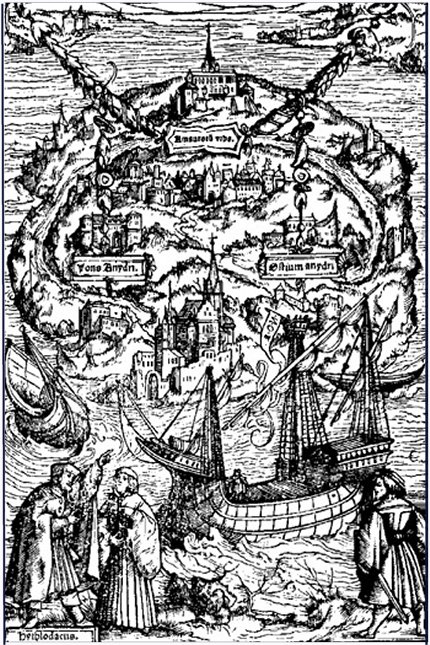
"Utopia" by Sir Thomas More,A fictional island society and its religious, social and political customs

..
Philosophers ought not to advise princes,for rulers are not interested in advice,
but would much prefer to have others assent to their fixed policies.
..
An economic system which allows private property drives the poor from the land and thereby creates thieves whom the existing laws require to be hanged :
such a system and policy is neither just nor expedient.
..
In opposition to the former ideas which are defended by Raphael Hythloday,a world traveler,Thomas More -as a character in the conversation- argues that a nonspeculative,prudential philosopher might be useful in politics,but Hythloday is skeptical.
.
(The name Raphael, though, may have been chosen by More to remind his readers of the archangel Raphael who is mentioned in the Book of Tobit. In that book the angel guides Tobias and later cures his father of his blindness. While Hythloday may suggest his words are not to be trusted, Raphael meaning "God has healed" suggests that Raphael may be opening the eyes of the reader to what is true. The suggestion that More may have agreed with the views of Raphael is given weight by the way he dressed; with "his cloak was hanging carelessly about him"; a style which Roger Ascham reports that More himself was wont to adopt. Furthermore, more recent criticism has questioned the reliability of both Gile's annotations and the character of "More" in the text itself. Claims that the book only subverts Utopia and Hythloday are possibly oversimplistic)
..
More objects to Raphael Hythloday's call for the abolition of money and private property by arguing that unless men have the profit motive,they will not work.
..
Hythloday describes Utopia,a carefully organized state in which the citizens engage in scientific farming according to assignments from magistrates and then return to the cities ;
they work a six-hour day and spend their leisure moments reading,attending lectures,and conversing on academic subjects.
..
In Utopia gold has no worth,
marriages are regulated,
work is cooperative,and
pleasure in accordance with virtue is the aim of Life.
.
(The communistic life style of a Utopian is a strange one coming from a rich landowner, though maybe influenced by the Spanish colonization of the Americas, which was bringing to European ears tales of ideal civilizations at about this time, such as the communistic Inca Empire)
..
(There are several religions on the island: moon-worshipers, sun-worshipers, planet-worshipers, ancestor-worshipers and monotheists, but each is tolerant of the others. Only atheists are despised (but allowed) in Utopia, as they are seen as representing a danger to the state: since they do not believe in any punishment or reward after this life, they have no reason to share the communistic life of Utopia, and will break the laws for their own gain. They are not banished but encouraged to talk out their erroneous beliefs with the priests until they are convinced of their wrong. Raphael says that through his teachings Christianity was beginning to take hold in Utopia.
The toleration of all other religious ideas is enshrined in a universal prayer all the Utopians recite.
“...but, if they are mistaken, and if there is either a better government, or a religion more acceptable to God, they implore His goodness to let them know it.”)
..
The Book : http://www.gutenberg.org/etext/2130
http://en.wikipedia.org/wiki/File:Utopia.jpg
http://en.wikipedia.org/wiki/Utopia_(book)
..
[Book 1: Dialogue of Counsel
(Woodcut by Ambrosius Holbein for a 1518 edition of Utopia. The lower left-hand corner shows the traveler Raphael Hythlodaeus, describing the island.)
The work begins with written correspondence between Thomas More and several people he had met on the continent: Peter Gilles, Town clerk of Antwerp, and Jerome Busleiden, counselor to Charles V. More chose these letters, which are communications between actual people, to further the plausibility of his fictional land. In the same spirit, these letters also include a specimen of the Utopian alphabet and its poetry. The letters also explain the lack of widespread travel to Utopia; during the first mention of the land, someone had coughed during announcement of the exact longitude and latitude. The first book tells of the traveler Raphael Hythloday, to whom More is introduced in Antwerp, and it also explores the subject of how best to counsel a prince, a popular topic at the time.
The first discussions with Raphael allow him to discuss some of the modern ills affecting Europe such as the tendency of kings to start wars and the subsequent bleeding away of money on fruitless endeavours. He also criticises the use of execution to punish theft saying that thieves might as well murder whom they rob, to remove witnesses, if the punishment is going to be the same. He lays most of the problems of theft at the cause of enclosure—the enclosing of common land—and the subsequent poverty and starvation of people who are denied access to land because of sheep farming.
More tries to convince Raphael that he could find a good job in a royal court, advising monarchs, but Raphael says that his views are too radical and would not be listened to. Raphael sees himself in the tradition of Plato: he knows that for good governance, kings must act philosophically.
However, he points out that:
“Plato doubtless did well foresee, unless kings themselves would apply their minds to the study of philosophy, that else they would never thoroughly allow the council of philosophers, being themselves before, even from their tender age, infected and corrupt with perverse and evil opinions.”
More seems to contemplate the duty of philosophers to work around and in real situations and, for the sake of political expediency, work within flawed systems to make them better, rather than hoping to start again from first principles.
“... for in courts they will not bear with a man's holding his peace or conniving at what others do: a man must barefacedly approve of the worst counsels and consent to the blackest designs, so that he would pass for a spy, or, possibly, for a traitor, that did but coldly approve of such wicked practices]

Sunday, September 13, 2009

The Great Learning,Tseng Tzu or Tzu Ssu,Ta Hsueh

..
The porpose of the Ta Hsueh is to teach man to know the great virtue,
to love the people,and to pursue the highest good.
..
To make the great virtue prevail and to bring peace to the world,man must first cultivate himself ; only then can he cultivate his family,his state,and the world.
..
To cultivate oneself one must rectify the heart,
but that involves making thoughts sincere,
and that in turn involves extending knowledge by investigation the things.
..
The pursuit of knowledge is to continue until man achieves moral excellence.
..
The investigation of things is an intuitive comprehension of the essence of things.
..
There are three principles of the art of government :
the ruler should cultivate his own moral stature ;
he should make use of wise and moral men ;
and he must esteem what is right above what profitable.
.............................................................................................
Ta-Hsüeh: "The Great Learning" (Fifth Century BCE)
Originally the Ta Hsüeh was a chapter of the Li-chi, the "Book of Rites," one of the five Chinese classics. Literary analysis suggests that it was written in the 3rd century BCE. During the Song Dynasty (960-1280), the Ta Hsüeh was considered sufficiently important to be singled out as one of the canonical "Four Books." Since both the Five Classics and the Four Books had to be memorized by Chinese students aspiring for a position in the Chinese civil service, the Ta-Hsüeh had to be studied twice.
How does the Ta Hsüeh emphasize the traditional Confucian value of the importance of knowledge?
The Ancients, wishing to illuminate with shining virtue all under heaven, would first establish order in their own states. (1) Wishing to establish order in their own states, they would first harmonize their families. Wishing to harmonize their families, they would first cultivate their own persons. Wishing to cultivate their own persons, they would first rectify their minds. (2) Wishing to rectify their minds, they would first seek to verify their opinions. Wishing to verify their opinions, they would first expand their knowledge.
The expansion of knowledge lies in the investigation of things. (3)
Once things are investigated, knowledge will be completed. Once knowledge is complete, opinions will be verified. Once opinions are verified, minds will be rectified. Once minds are rectified, persons will be cultivated. Once persons are cultivated, families will be harmonized. Once families are harmonized, states will be put in order. Once states are in order, there will be peace all under heaven.
From the emperor to the common people, all must see the cultivation of their own person as the root of all else. If roots are in disarray, there will never be healthy branches.
Translated by Lydia Gerber
(1) "All under heaven" (t'ien-hsia) was a term used for the Chinese empire rather than for the world at large. Before 221 BCE, the Chinese empire consisted of a number of very strong, independent states.
(2) "Mind" (hsin) can also be translated as "heart." Classical Chinese does not differentiate between the rational and emotional aspects of a person the way western languages do.
(3) The Chinese term wu--translated as "things"--basically means "all that is outside oneself." It is usually translated either as "things" or "affairs".
..............................................................................................
About Tseng Tzu : http://bartleby.com/44/1/8.html
About Tzu Ssu : http://en.wikipedia.org/wiki/Zisi
..

Thursday, September 10, 2009

Termites of the State

..
By Han Fei Tzu,280-233 B.C.
Political Philosophy
Machiavellian
Legalists of Ancient China : Fa Chia
..
Nothing interests men except material profit.
..
Laws are necessary in order to control men ;
he who obeys the law is good,
and he who disobeys the law is bad.
..
Nothing is more important than having a prosperous state with strong armies ;
to make the realization of his goal possible,
the ruler should use the promise of reward and the threat of punishment as instruments for the control of selfish citizens.
..
To make goverment successful and to achieve a uniformity of standards,
actualities must be made to conform with names ;
the behavior of citizens should match the descriptions prescribed by the law-giving rulers.
..
If laws are made according to TAO,the way of nature,the state can rule itself.
..
The five termites of the state are :
the political advisers,
the scholars,
the merchants,
the artisans,and
the knights-errant.
..

Sunday, September 6, 2009

Politics by Aristotle

..
The morally virtuous man performs acts according
to a rational mean between extremes of excess and deficiency ;
so also does the state.
..
The good states are :
a.monarchies,
b.aristocracies,and
c.polities (Πολιτείες) -constitutional governments -;
the corresponding bad states are :
a.tyrannies,
b.oligarchies,and
c.radical democracies.
..
Policies which lean toward the democratic form of government
possess the greatest political stability and
are least liable to revolutions.
..
The art of government involves the use of practical wisdom.
..
Since the best life is one which combines action with contemplation,
the ideal state aims at providing sufficient external goods
to permit the pursuit of virtue and happiness.
..

Sunday, August 16, 2009

Statesman by Plato

..
The problem concerning the Athenian Stranger and Socrates is that
of defining the IDEAL STATESMAN.
..
The statesman,or king,
is a member of the class of those who direct action ;
he initiates directives ;
and he is distinguished from those who build LIFELESS things
by the fact that his concern is with a living herd,
the CITINZERY.
..
The art of statesmanship is not a function of the kind of state to be governed ;
a good statesman can rule no matter what the form of government.
..
Laws are necessary in a state,
but the ruler is more important than the laws ;
in many cases he must judge when the laws do not apply.
..
The statesman is superior to other men who practice the various arts of ruling men in that
he must decide which of the other arts is to be used for the benefit of the state ;
in that sense,statesmanship is the art of all arts.
..

Sunday, August 2, 2009

Mo Tzu

..
Universal love is the source of the good,
and by rewards and punisments human beings
can be encouraged to love universally.
..
Uniformity of value standards is achieved by establishing
the way of the most virtuous and capable
"Son of Heaven" as the moral standard.
..
Aggressive war should never be practiced since
it is neither politically nor economically advantageous.
..
..

Wednesday, July 29, 2009

Lun Yu,the 499 sayings of Confucius

..
THE ANALECTS OF CONFUCIUS
..
JEN,the ideal relationship among human beings,
is the perfect virtue of men.
..
Man is basically close to jen by his very nature,
but his action should be controlled by LI,
the rules of propriety.
..
The CHUN-TZU,or IDEAL MAN,
is one who practices jen in accordance with LI ;
consequently,
he treasures and seeks the TAO,
the right Way.
..
..

Monday, July 27, 2009

Laws by Plato

..
Laws are initiated when communities seek to fix custom,
but societies fail when ignorance triumphs over wisdom,
or when intemperance defeats temperance,
or when freedom is lost or becomes licence.
..
The best form of government is a combination of democrasy and monarchy,
for such a state combines freedom and wisdom.
..
Legislation should be designed to insure freedom,harmony,and understanding ;
the effort should be made to initate the good and the gods.
..
Where the laws are above the ruler,
the state has the possibility of salvation ;
the best ruler is one who can enforce the laws by persuation and command.
..
The laws should provide for censorship of the improper kinds of music,
dancing,poetry,eulogies,and drama ;
they should discourage all love but the love of soul,and
they should provide for the rehabilitation of criminals.
..
The gods must exist since the soul,
that which can more itself,
is essentially dependent on the divine.
..

Tuesday, July 21, 2009

Wednesday, July 8, 2009

Republic by Plato

..
'' What is Justice ? ''
..
Thrasymachus suggests :
'' Justice is whatever is to the interrest of the stronger party
-since the stronger party makes the laws and enforces them- ''.
..
Socrates argues :
'' Rulers sometimes err and that,in any case,
the art of government,
like other arts,
is directed to the interests of those to be affected,
the people themselves ''.
..
Socrates claims :
'' The just man,
provided he has knowledge,
can rule both himself and others,
and that concern of the just man is not for himself alone ''.
..
To clarify the idea of justice and to prove its worth,
Socrates leads a discussion concerning justice in the state ;
he constructs the idea of an ideal state,
one which exhibits justice.
..
Any state needs :
1.guardians - rulers,
2.auxiliares - soldiers,and
3.workers .
..
Each class does its proper business without interfering with the others ;
analogously :
..The just man is one in whom the three elements of his nature,
1.the rational,
2.the spirited,and
3.the appetive,
are harmonized.
..
The IDEAL REPUBLIC is one in which,
the classes are carefully built up by
1.controlled breeding,
2.education,and
3.selection ;
Society is communized in order to eliminate quarrels about personal property.
..
The guardians of the state should be educated as philosophers,
having been prepared by training in music and gymnastic.
..